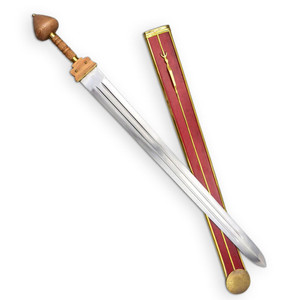

Roman 3rd Century Spatha
Deepeeka
$142.99
$168.99
(You save
$26.00
)
Write a Review
Deepeeka
Roman 3rd Century Spatha
This Late Roman Spatha represents a refined interpretation of Roman sword design from the 3rd to 4th century CE, developed with input from historical researcher Christian Koefer. Drawing from archaeological examples, this model reflects the transition of Roman swords toward longer, more versatile blades that would later influence early medieval weaponry.
The blade features a pronounced dual fuller design, reducing weight while maintaining stiffness and improving handling characteristics. This construction allows for efficient cutting performance while preserving the strength required for thrusting, making it a versatile weapon in both infantry and cavalry contexts.
This piece stands out as a research-driven reconstruction, offering a more historically grounded interpretation of the Late Roman spatha compared to standard production models.
Balanced for cutting and thrusting
Ideal for reenactment, study, and collection
Forged from EN45 high carbon steel, the blade is left unsharpened for safe reenactment use. Its extended length and balanced profile provide excellent reach and control.
Historically, hilts of this type were often crafted from bone or antler. In this version, Deepeeka has used carefully hand-carved wood to replicate the form while ensuring durability and consistency. The hilt is secured with a brass pommel nut, maintaining traditional construction methods.
The sword is paired with a wooden scabbard wrapped in leather and fitted with brass lockets, chape, and suspension loop, allowing for authentic Roman-style carry.
Overall Length: 39″
Blade Length: 30 3/4″
Weight: 2 lb 3.9 oz
Edge: Unsharpened
Width: 56.6 mm
Thickness: 4.7 mm - 4.4 mm
Pommel: Nut
Point of Balance: 9 7/8″
Grip Length: 4 1/2″
Blade Material: EN45 High Carbon Steel
Type: Spatha